

Table of Contents:
Why Spine Care Is So Specialized
When Exercise Starts Hurting Your Back
Why Warm-Up Matters More Than You Think
Common Spine Injuries: What You Should Know
Osteoporosis: What Everyone Should Know
How Can You Prevent Osteoporosis?
The Role of Vitamin D3 in Bone Health
Understanding Bisphosphonates for Osteoporosis
DEXA Scan: When Should You Start?
Does Every Osteoporotic Fracture Need Surgery?
Understanding Slip Disc
When Does Slip Disc Need Surgery?
Can Medications Cause Osteoporosis?
Osteoporosis or Osteoarthritis: Understanding the Difference
Lumbosacral Pain: Understanding the Cause
Why Does Bone Pain Increase after Menopause?
How to Build Your Bone Bank
Tracking Progress During Osteoporosis Treatment
Is Milk Enough for Your Calcium Needs?
Does Sunscreen Affect Vitamin D Absorption?
Does a DEXA Scan Hurt?
Osteoporosis in Children: Why Does It Happen?
Breaking the Myths About Osteoporosis
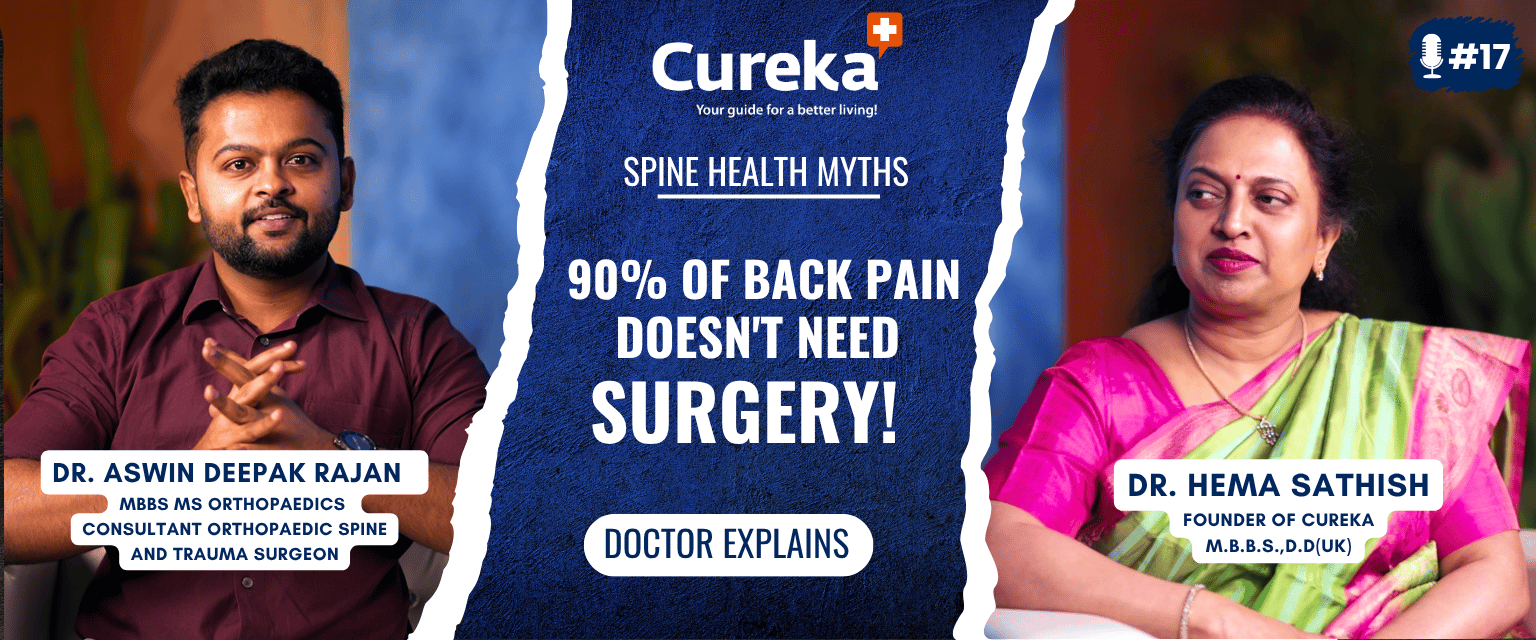
Dr. Hema Sathish:Hello everyone, we have Dr. Ashwin Deepak today. He is an orthopedic surgeon and super specialized in spine. At this young age, he is a dynamic surgeon who has already published six journal articles and has presented in national and international conferences. So welcome to Dr. Ashwin Deepak.
Dr. Ashwin Deepak: Hello everyone.
Dr. Hema Sathish:So, doctor nowadays we see so much of spine problems and you know to have a orthopedics itself is such specialized field and to have a spine super specialization I mean why is it called for can you explain?
Why Spine Care Is So Specialized
Dr. Ashwin Deepak: So, actually nowadays due to wrong sitting posture and back posture people many of them are not maintaining the good posture when they are sitting. And increased work from home jobs. So post COVID era has been changed. More work from home, people are more working from the homes are there.
Dr. Hema Sathish:Yeah, and I think they don't have to sit in a particular position when they are at home.
Dr. Ashwin Deepak: So they are sitting constantly for more than eight hours and they are maintaining a bad posture like sitting in a sofa or not having a proper support in their hand when they are sitting. They are just bending forward and sitting. So the spine as a super specialist from ortho to take care of the specific spine and both cervical and from top to bottom entire spine, back. So he specializes.
Dr. Hema Sathish:That's true right and even the usage of phone has increased.
Dr. Ashwin Deepak: Yeah usage of phone, laptops and gadgets. So to be frank the gadgets, the e-gadgets we are using, the people tend to bend forward and looking the gadgets so that causes issues in the neck and as a whole in the back also.
Dr. Hema Sathish:So you specialize in neck? and the back right?
Dr. Ashwin Deepak:Yeah, I am especially from top to bottom. What I see is from neck, central back and lower back.
Dr. Hema Sathish:Okay, okay. So that's very interesting because neck is something which needs a lot of attention today.
Dr. Ashwin Deepak:Neck needs attention. The young patients have more issues in the neck. And the old patients, 40, 50, has more issues in the back. What we are seeing for the past five years post COVID due to the prolonged phone usage where it's more common in the young and office jobs, desk jobs are causing back issues. And in young issues, young patients, they're having more neck issues. Neck bending posture they have keeping the posture of the neck like seeing the mobiles and seeing the tabs, laptops and they are not bending the back they are more bending the neck forward so that causes more neck pain so more prolonged bending more than one hour is not done advice advisable for any neck or back issues so you should keep on changing the posture for every 40 to 40 minutes to one hour.
Dr. Hema Sathish:Oh okay that's quite interesting right. So when you say youngsters having neck problems, but there is a rise in youngsters having back problems also. I think one is because the over enthusiastic ones doing lot of exercise.
When Exercise Starts Hurting Your Back
Dr. Ashwin Deepak:Lot of exercise and people once they get an initial attack of neck pain or back issues when they are doing a laptop job or doing a desk job, what they do is the people near by they will say you go to join a gym, take a membership.
Dr. Hema Sathish:Oh yeah.
Dr. Ashwin Deepak:Your pain, everything will go off. So what they do, they directly go to the gym and they without doing a proper core muscle strengthening exercise or back strengthening core stabilization initial like a warm up what I will say for the few people so they do not do a proper warm up. So directly go and they consult with some trainers or they themselves seeing some videos they start weight lifting.
Dr. Hema Sathish:So that's one big thing right. They see some videos, some reels somewhere.
Dr. Ashwin Deepak:So they see the reels and they themselves start some diet and they start doing weight training. So direct weight training is not advisable. For strengthening your core muscles so they directly go and do a dead lifting or they directly go and directly do weight lifting of 15 kgs as a stretch 20 kgs without doing a daily warm-up, warm-up is not a single day thing okay so warm-up is like you have to do in morning also you have to do in evening also so every time you have to do warm up for a general activities warm up is needed for a gym weight training also warm up is needed warm up is a key thing so if you don't do a proper warm up for any of your muscles of the body and you are directly going into strengthening or straining even it is a back or your arm or any muscles so you will immediately get a spasm
Dr. Hema Sathish:Okay.
Dr. Ashwin Deepak:So that's a lot of thickening of the muscle.
Dr. Hema Sathish:Okay.
Dr. Ashwin Deepak:We get in a contracted state and it will cause us a pain.
Dr. Hema Sathish:Okay. Yeah That's quite interesting because I think warm-up everybody talks about it But nobody follows it because we feel it's fine. I'm already active then I go by a walk.
Dr. Ashwin Deepak:Yeah I am the people say I am daily walking eight or eight dozen steps.
Dr. Hema Sathish:Oh, yeah
Why Warm-Up Matters More Than You Think
Dr. Ashwin Deepak:So then I don't need a warm-up It's not like that. Walking is not a walking is a exercise yeah that gives activity to their entire body, if you want to work up a specific group of muscles for example i am saying if you want to work up your back muscle there are specific exercise like spine extension exercise and there are specific exercise like i will say that McKenzie type of exercise that is what you see is a spine extension exercise, So there is a specific group. Few people will need an extension exercise, few people will need a flexion exercise. It depends upon how they are having a, which group of muscles are weak. So we have to assess the group of muscles they are weak and give a specific curated physiotherapy or an exercise for five patients if they have extension weakening we have to give specific exercise.
Dr. Hema Sathish:Okay.
Dr. Ashwin Deepak:And another five groups are having a flexion weakness we have to give a specific exercise.
Dr. Hema Sathish:Okay. So that's a real eye opener to know.
Dr. Ashwin Deepak:Yeah.
Dr. Hema Sathish:That for the back there are different types of exercise depending on what muscles needs to be strengthened. So that needs a lot of help then. Yeah. So when we talk about spine injuries, I mean what are the common spine injuries usually you see?
Common Spine Injuries: What You Should Know
Dr. Ashwin Deepak:So spine injuries, so maybe there are two types. So you have to know which age group of they are getting injury and what type of injury they are getting. So the mode of the injury and which age they are getting the injury. So for example, it's a younger age group between 20 to 40. The spine injury if it's happening, it should be a high velocity injury. Like if they are travelling in a car or a road traffic accident. So these patients should be assessed properly not only you assess the back you should assess how their limbs are there if they are moving the limbs if they are able to walk or not so once they come to your consultation or they are going to somewhere they are assessing themselves they should know not only they should know how to assess the back So they should know how they are moving the limbs. So if a patient is having, patient or any people, so general I am talking, so if they are having a back pain post injury, after injury if they are having a pain, so you should see if they are moving the limbs. If they are not moving the limbs, then it is an emergency. it's an emergency if they're not moving the limbs then it is an emergency that means their spinal cord has been compressed or compromised due to the there is a fracture only the fracture so it is not mandatory that only a fracture can cause a spinal injury even without a fracture your cord can be get injured
Dr. Hema Sathish:Oh okay.
Dr. Ashwin Deepak:If you want a ligament injury so the spine is a complex structure spine may has not only the bone there are surrounded ligaments if there is an injury they may get a cord injury and limb may be weakened. So another group is fragility fractures. Fragility means weakening. So weakening happens in old age. For example, a 50 year old person or a 16 year old person if they are coming you should know if they are telling a back pain or you have to assess back pain is for how much you can ask them they should know back pain is for how much years they are having a month's duration or a year's duration and they will be telling you they will be telling you that i have a back pain and i am having a flexed posture Flexed posture is curving. When I am getting... When they bend down in the front, right? When they are trying to walk, my spine is getting bending forward.
Dr. Hema Sathish:Okay.
Dr. Ashwin Deepak:So that means they are having... That means they may attend... Who are coming with the pet, the relatives. They will tell his height was... That is the difference in his height when he is walking.
Dr. Hema Sathish:So that's true right they will become okay
Dr. Ashwin Deepak:So it means there are multiple compression fractures so as their bones are weak they would have simple activities like they are getting from the bed they are twisting from the when they are sitting and they are getting up so just coughing or sneezing may cause fractures in these groups
Dr. Hema Sathish:Oh that means the osteoporosis is pretty severe
Dr. Ashwin Deepak:So just remember that the bone will be like a paper
Dr. Hema Sathish:Oh my god that's scary.
Dr. Ashwin Deepak:That will be scary because when they just stand or just sneeze or simple cough may cause a fracture. So that may be their early symptom. That means the osteoporosis or that fragility has not developed a single day. This fragility has been in last 10 years.
Dr. Hema Sathish:Oh it's been slowly.
Dr. Ashwin Deepak:Slowly, slowly it's developed and a simple cough or sneeze or getting from a simple position or position change may have get a pain. So that means this is a these fragility fractures are more notorious for their silency. They will be silent for last 10 years.
Dr. Hema Sathish:Oh that's bad.
Dr. Ashwin Deepak:Yeah. Sudden a jerk in their spine may cause a fracture.
Dr. Hema Sathish:So, can you tell like when if osteoporosis is something which is like you know everybody talks about, but we I do not think a common man really understands what osteoporosis exactly does. Can you explain that a bit?
Osteoporosis: What Everyone Should Know
Dr. Ashwin Deepak:Yeah, the osteoporosis. So, just remember that osteoporosis, osteo means bone. Porosis means weakening. So it's a simple terminology called bone weakening. So the bone weakening happens for long duration for last 10 years. So it's most common in the female persons and the male persons also. The onset will be in 40 years for a female population and because in most commonly population affected is females when in the postmenopausal age. So, postmenopausal age the estrogen hormone will be deficient and it will be depleting. So, their bone mineralization will be depleting. So, in so, then next next problem is the male will will be also affected or not. Why always females not like that males will also be get affected but there will be affected in the later part of life like you can say 65 75 so it's not like sedentary lifestyle won't affect or not sedentary lifestyle will definitely affect and a males having an osteoporosis at early age group for example 40 years male person having an osteoporosis that means they have a sedentary lifestyle or they are super obese their BMI is high they are not able to walk for a continuous for five minutes that they are sitting alone they are sitting for some 10-12 hours they are just sleeping they are not properly following the diet healthy diet so osteoporosis not about all the fragility it can be prevented by proper diet, physical therapy and proper exercise training. So not about your I am walking well.
Dr. Hema Sathish:So how can one prevent osteoporosis?
How Can You Prevent Osteoporosis?
Dr. Ashwin Deepak:I can prevent my osteoporosis. You cannot not say like that walking won't prevent you have to do a muscle strengthening exercise and weight bearing exercises. So the two groups first all the way I always say strengthen your muscle first then strengthen your bone.
Dr. Hema Sathish:So, you said if you are obese you can get osteoporosis. So, if you are lean you won't get osteoporosis is it?
Dr. Ashwin Deepak:Yeah, it's not like that. So, if you are lean also, so lean means you don't have a muscle, you don't have a fat. So, you are having only a bone. That means your body mass indexes and your entire body weight is taken by the bone.
Dr. Hema Sathish:Okay.
Dr. Ashwin Deepak:So, a lean also will get a, a lean person will also get a fragile.
Dr. Hema Sathish:A lean, but if your muscles are exercised well, then that's.
Dr. Ashwin Deepak:Yeah, yeah, yeah.
Dr. Hema Sathish:If it, if you are just lean in a sense, very skinny thin. Skinny thin.
Dr. Ashwin Deepak:Yeah, you are very skinny thin and you don't have good exercises and muscle is very muscle is also thin. So that is a term body mass index.
Dr. Hema Sathish:Yeah.
Dr. Ashwin Deepak:So you have to maintain that you should not be underweight. You should not be overweight. If you are between maintaining that level with your good dieting and good exercises, I'm again strengthening on muscle strengthening and weight bearing exercises specifically and specific group of muscle exercises, then you can absolutely prevent osteoporosis.
Dr. Hema Sathish:Well, there are some medications available for osteoporosis, right? That would include quite a lot of like not only calcium, then vitamin D3 also plays a role. So can you tell, first we'll talk about vitamin D3, then we'll go to the medications.
The Role of Vitamin D3 in Bone Health
Dr. Ashwin Deepak:So vitamin D3 is a thing, which will help the absorption of the calcium so the common persons they do mistake is sir I am taking calcium for 3 months I am not getting any change in my body I am not getting any strength I am not getting rid of this osteoporosis, osteoporosis is not about taking only the calcium So, you take vitamin D3, once the vitamin D3 goes in it will absorb the calcium. So, now recently they are telling vitamin K2 is also important. So, if you if you are taking vitamin K2, vitamin D3 if two things. So, it will increase the absorption of the calcium. So, absorption means what you take inside the calcium should reach the bone that should be a carrier. So, if the vitamin goes in, it should not directly go out. It should go to the bone. So, these are the carriers. So, vitamin D3 and vitamin K2. This will help in more absorption. It's not like I am taking a 3 months, 6 months calcium only. That won't support. So, you should super add with. So, not always you supplement your calcium with only the vitamin. Tablets so you can take with the food dieting also.
Dr. Hema Sathish:Okay that's nice nice to know actually and vitamin k2 wow okay so something new in the market now so there's one more thing right okay so there are bisphosphonates for uh osteoporosis, So when would you advise someone to take the bisphosphonates because usually we are spoken we are always talking about vitamin D3 or you know calcium and vitamin K also but when do we take this?
Understanding Bisphosphonates for Osteoporosis
Dr. Ashwin Deepak:So bisphosphonates not a over the counter medicine.
Dr. Hema Sathish:Yeah, it has to be prescribed, right?
Dr. Ashwin Deepak:So you don't go to a as a any person I advise them don't go to a pharmacy by seeing the online or any you google it and directly go I need a response no one will give you so you should not you should not there are specific treatment protocol for osteoporosis So there are some scoring systems and some additional scanning also. So if you are having, if you go to a spine specialist or orthopedician, you get access to yourself first. Not everyone will need a bisphosphonates. Bisphosphonates should be started if you have a low DEXA score. So that is a specific scan has DEXA. So it's an X-ray absorptiometry scan. So dual energy. So what you have to go is...
Dr. Hema Sathish:You go and take the scan yourself or that also you need a recommendation from the doctor?
Dr. Ashwin Deepak:That should be the recommendation by the orthopedician or a spine specialist. So you assess the age for mostly the doctors or spine specialist will prescribe a DEXA scan not for young age groups. So if you are a female you are postmenopausal age and you are having a back pain or a diffuse body ache. Or if you are having a male person who are coming to you with around 60-70 age group then they are you are suspecting an osteoporosis like diffuse body pain or they are having a kyphotic, kyphotic means bent posture so what we call that is a kyphosis in our term So that person you can prescribe a DEXA scan. So DEXA scan that is a scoring system.So if you like scoring if it's been minus. So for a simple I will explain that is the minus 1.5 to minus 2.5 minus 2.5 to minus 3.5. This minus 2.5 minus 3.5 are high risk and if it's some will present even with minus 4. That means they will have already they have a history of fractures. So bisphosphonates you should prescriber this group of patients who are having an osteoporosis not osteopenia. Penia means is less than minus 1.5. They are in the initial stage group. That can be managed with the exercise, dieting and muscle.
Dr. Hema Sathish:That is so heartening to know right that that can help a lot more. When you spoke about DEXA scan, it can be taken for prevention also, right? So, what age would you suggest we should start and at what intervals you should repeat it?
DEXA Scan: When Should You Start?
Dr. Ashwin Deepak:Yeah. So, DEXA scan can be taken for a postmenopausal age group, females more than 45-50 age group, males I will advise more than 65. So you can repeat the scans if you are diagnosed with osteoporosis and you are in a treatment you repeat every 2 years. That like I am telling a score of -2.5 and between -4.5 and you are in a treatment like bisphosphonates or any injections there are new injections in the markets like denosumab and terifaratide that group of injections or you are in a bisphosphonates tablets which this treatment will go along for 2 years duration. So, once you complete a first course of treatment then you need to repeat every 2 years or else if your score is very if you are thinking you are not in this group of minus 1.5 age that scoring system 0 to minus 1.5 that means you are in a not in osteoporotic you are in osteopenic. So, but you have to prevent osteo going into porosis. So that means you have to repeat for once in a 5 years.
Dr. Hema Sathish:Okay, okay. So it takes 5 long years.
Dr. Ashwin Deepak:Yeah.
Dr. Hema Sathish:So that is the same grace, right? So in between you have lot of time.
Dr. Ashwin Deepak:Yeah, it is not like you have to repeat every 6 months or 1 year.
Dr. Hema Sathish:Okay, okay.
Dr. Ashwin Deepak:Depends upon the initial screening, initial scoring.
Dr. Hema Sathish:Okay. So then that is really nice to know. And in case if they develop a fracture, I mean what would you advise? I mean if you feel osteoporosis leads to a fracture, do you jump into a surgery or what exactly would you do?
Does Every Osteoporotic Fracture Need Surgery?
Dr. Ashwin Deepak:So any osteoborotic spine fractures so you should see where the fracture is happening, so i say already cell is in the upper spine or mid spine or a lower end so in the medical terms i will say it's a cervical spine or a thoracic spine or a lumbar spine that is upper mid back and lower back So, if it is in a lower back, so you have to assess which type of fractures. You cannot directly say by seeing the X-ray. So, you should educate the person you are coming to do an other scanning modalities like MRI, magnetic resonance imaging, so which is a gold standard. So, you have to see whether it is a fresh fracture or a old fracture and the compression is very more. The height of the bone, the height of the bone matters. The height of the bone is decreased more. That means that is the most common reason they are getting the height reduction and they are getting the bending of the spine. So if they are coming with their fresh presentation and you are prescribed an MRI and you are diagnosed as osteoporotic fracture along with your dexasporing. Then you can do a minor procedure also. If the height is more than 50% reduced, you can do a minor procedures. No need to put big procedure. You can do a cement injection like the procedure called vertebroplasty or a kypoplasty. These are minimal procedures. If they are having a mild compression, only the 20% has been reduced, then you can do a bracing. Ask them to wear some belt or a brace and bed rest for some 2-3 weeks and slowly doing a physio and ambulating. But they have to hold the belt or a brace which you are prescribed for 2 months duration.
Dr. Hema Sathish:Okay, so that's the minimum time required. But then they improve quite a bit.
Dr. Ashwin Deepak:Yeah, they will improve, but you have to repeat the x-ray, no need to repeat the MRI. You can do an x-ray, just assess whether the height has been still maintaining or still compressing.
Dr. Hema Sathish:But if you start the treatment, it does not, the height of the, this thing does not improve, right?
Dr. Ashwin Deepak:What is gone is gone. So you cannot achieve the height. So I am assessing whether it is 50% is there. If it is not 50%, if it is 20%, it is very collapsed. Then you have to intervene. If it is not, if the height is achieved. And that one more thing is important is not one vertebrae. One vertebrae means one bone. The spine having many bones are there. If multiple bones are fractured and multiple bone height has been reduced, then you have to intervene. Because that patient won't do well when you follow. They come with the bend, they go on bending, bending and the spine will get a bend posture and it will be difficult for them walking. So, if you are having a multiple fractures and multiple height has been reduced, better intervene with a surgical intervention and you have to explain to the person who are having that condition.
Dr. Hema Sathish:There is one more condition which is like slip disc in common man's term. So this is something which is very common. I have seen it in youngsters also and older people also. I think it is equally or it is more in elder?
Understanding Slip Disc
Dr. Ashwin Deepak:It is not more in the elderly. It depends upon the person, work nature and the work culture. So I have seen the patient with the slip disc in a 16 year old, 17 year old.
Dr. Hema Sathish:Oh that is horrible.
Dr. Ashwin Deepak:So they are having 16 and the only thing is the slip disc, the term slip disc is very broad.
Dr. Hema Sathish:I know. Yes. Very loosely used also.
Dr. Ashwin Deepak:I have a slip disc. See if someone is coming, I have a slip disc. Then as for a spine surgeon, I will be concerned whether it is a disc bulge or a disc protrusion. So slip disc is not a slip disc. You have to identify whether the disc has been some bulge. So for example, if someone, some person is not having any symptom, no back issue, nothing. Just send him for an mri do a mri he will have a disbulge, disc bulge is an a degenerative thing it's also degenerative the same disc when you are 25 year old it won't be there when you are 35 or 45. So it's a day-by-day degenerative process so not every discbulge persons will have a symptom not every disc bulge patients will come end up in doing an intro need an intervention or an surgery although this bulge is common in adolescent group nowadays
Dr. Hema Sathish:What's the reason for it?
Dr. Ashwin Deepak:Due to the bad posture
Dr. Hema Sathish:Oh yeah
Dr. Ashwin Deepak:Post, like after 2020, now we are in the present decade of 2030. So the second half we are in the decade. So now still the work from home culture is persisting. That is notorious. That is notorious that even the young age group between 18 to 27, so who are in a bank job or IT job, and even it is affecting the doctors also who are preparing for their exams.
Dr. Hema Sathish:Oh, that's right.
Dr. Ashwin Deepak:Because they are studying more than 8 hours, 10 hours for their PG preparations. So one should be take care that I will advise for younger generation never sit or never in a single position for more than 40 minutes. You keep on changing your posture. You keep on doing a minor spine stretch exercise when you are walking or standing to maintain a proper posture.
Dr. Hema Sathish:So that's a very nice thing to say.
Dr. Ashwin Deepak:Morning you do a half an hour you do a simple spine stretching not only spine as an orthopedician i advise them to do a warm-up for every group of muscles and don't miss the spinals you do a spine extension exercise good diet good posture good weight management it won't make your spine to age
Dr. Hema Sathish:Okay good weight management a self weight self
Dr. Ashwin Deepak:Yeah
Dr. Hema Sathish:Yeah people shouldn't think carrying weight..
Dr. Ashwin Deepak:No not carrying it you are or maintain your uh yeah body mass
Dr. Hema Sathish:Yeah so that's that's uh that's something very very important right and uh when slip disc is something very scary many of them have undergone surgeries also so when do you say they have to do a surgery or when it's going to be alarming that the person should say no i need to go to a surgeon and make sure i'm treated
When Does Slip Disc Need Surgery?
Dr. Ashwin Deepak: So yeah so the disc i already told the slip disc may come with a disc bulge or a disc protrusion so the disc disc protrusion is concerned for a spine surgeon or any orthopedic surgeon which you will see only in a magnetic resonance imaging like mri So, there are two types of person. One will come with back pain and one will come with back pain with any thigh pain. Thigh pain or leg pain. Sir, I am having a back pain along with thigh pain and my leg is numb. And my legs are not moving like specifically my great toe or any finger is not moving that means you have to do an emergency MRI and you will see a large disc protruding and pressing the nerve root nerve root means the lower back spine all your limbs your legs calf will get functioning from the The supply is coming from your lower back. That is the nervous supply. The nerve which is coming from your lower back is supplying your thighs, calves, your toes and your ankle, ankle and foot. How you are walking and how your strength you are walking. It's all determined by your lower back spine nerves. See any of the disc is bulging or it's protruding and you are seeing the MRI and he has been pressing the specific nerve root, right side or left side. There is specific numbering L4, L5, S1 like that is most common. Disc bulge or potential lower most part of the it's most common is L4 L5 okay and if it's L4 L5 disc bulge and you will have a right side bulge or left side bulge or a center bulge which is center bulge most commonly you will get pain or any numbness in both limbs if you're having a right side the right side pain will be there so you have to know the every person and everyone should know the red flag there are specific red flag signs all the disc bulge i'm repeating all the disc bulge all the disc protrusion irrespective of the age don't need a surgery don't need a surgery at the initial stage all right so you have to assess the person you are coming they are having a severe pain and if their legs are not moving they are not able to pass their urine or their day-to-day things not able to pass and they are not able to walk not able to stand they are severe having a pain due to this issue Then you can do a surgery. And they are having a, you have MRI showing a disc bulge L4, L5, L5, S1. They are having a mild pain. They are able to do a day-to-day activities. Still you can, and they are neurology. Neurology means they are able to move their limbs as the normal persons, compared with the normal person. Then that person, you can give some medications and you can give them a physiotherapy. A bed rest should be given for two to five days only. The most common mistakes we are doing and everyone is doing Like if a back pain or a disc bulge, don't tell them to take a bed rest, complete bed rest for two weeks or three weeks.
Dr. Hema Sathish:That's commonly advised by all of them, right? I think the spine surgeon wants to differ in that.
Dr. Ashwin Deepak:I have to give a different opinion in that. Give a medication or give an injection or anything, keep them a rest for two to five days once the pain subsides ask them to mobilize them and ask them to do a muscle strengthening because it's mandatory to say strengthen the muscles the muscles if the muscles is not still the entire mechanism is of the disc bulge or a disc protrusion what you will say If your muscles are not strengthened, when you are walking your body weight goes entirely in the bone. The disc is the thing which is a cushioning part between your two bones. So, if your entire bone is taking your body weight not the muscles then your cushion will come off.
Dr. Hema Sathish:True.
Dr. Ashwin Deepak:So, always do a strengthening exercise once your pain gets subsided.
Dr. Hema Sathish:That's really a very very valuable advice.
Dr. Ashwin Deepak:Yes.
Dr. Hema Sathish:We spoke about quite a few medications for osteoporosis, but there are sometimes a person takes medicines and due to that gets osteoporosis. So, can you explain a little on that?
Can Medications Cause Osteoporosis?
Dr. Ashwin Deepak:So, there are some group of medicines for the conditions, specific conditions, which they are taking for long durations. So, for example, if you take a person taking an hypothyroid medicines for hypothyroid the persons will take an medicine called thyroxine yeah so supplements and if your thyroid is not functioning they will take check the test like thyroid function test and they will prescribe a thyroid medicine your general physician or an endocrinologist will handle that and they will give a specific dosage so some persons when they are diagnosed with the hypothyroid initial stage the physicians or someone practitioners will give initially high dose to correct that. So, they are based upon their lab levels. And the persons if they are continuing the medications for a very long duration of the same dosage. For example, if I am telling a 100 microgram or 75 microgram up to 125 microgram, they are taking L-Tyroxine for long duration. They may cause weakening of the bone or osteoporosis. And there are some anti-epileptic, epilepsy means seizure medications, they are having a fits or seizure and that person they have to take for prophylactic to prevent the seizure, for lifelong they will take. So, these persons compared to the normal group of person, they may have a early onset of osteoporosis and fragility. And some other psychiatry medications so these are the chronic medications so the they have to take for lifelong so that medication may cause osteoporosis in the early onset.
Dr. Hema Sathish:Okay so those so you have to judiciously take yeah long term.
Dr. Ashwin Deepak:Yeah and these and as a spine especially for orthopedician So if you are diagnosing in osteoporosis, you should ask the, this history, the people will miss. Other drug intake history. So you should ask them, have you on any medications? Like I said, the three groups.
Dr. Hema Sathish:The thyroid medications very commonly.
Dr. Ashwin Deepak:Yeah, this thyroid. And some may take, and some may hide also. Some may take steroids. Steroid is more prone. Even in the young age group, they give steroids for their body building. And if you are containing the steroid. Or some may having an arthritis or any asthma like, so you mostly bronchial asthma, they will be inhaling the steroids for a long duration. So, most commonly these thyroid medications, steroids and other anti-epileptic.
Dr. Hema Sathish:Inhalation of steroids can also lead to osteoporosis.
Dr. Ashwin Deepak:Yeah, inhalation of steroids, any mode of intake of steroids for longer duration, not for shorter, most common is injectable steroids. If you are taking injectable steroids that may accelerate your osteoporosis. Or it may make pay away for an onset or early onset of osteoarthritis if you are taking a steroid in a very young age group.
Dr. Hema Sathish:So osteoporosis is one condition and there's osteoarthritis so is it osteoporosis leads to osteoarthritis or osteoarthritis leads to osteoporosis
Osteoporosis or Osteoarthritis: Understanding the Difference
Dr. Ashwin Deepak:Both are different so as i initially said osteoporosis so different uh divide the word osteoporosis osteo means bone porous means weak So, it is affecting the bone, bone is getting the weak. So, osteoarthritis is an different condition. Osteoarthritis means osteoarthritis, arthritis is the cartilage. So, what you tell is a cartilage, cartilage is a cap covering your joints. So, if there is two bones, so two bones one joint, there is a thing called cartilage. If the cartilage is getting damaged that is osteoporosis, osteoarthritis.
Dr. Hema Sathish:So, osteoarthritis is only in the knee is it?
Dr. Ashwin Deepak:Osteoarthritis affect joints joints or any joint and the term will be different in spine spine also having a joint yeah spine is not about all only the disc issue so every back pain is not a disc issue so spine is also having a joint called facet joint you will tell it's a facet facet means it is the back of the spine the disc is in your front of the spine the spine one more joint is in the back of the spine So, that term is called not osteoarthritis, it is called spondyloarthritis, what we call is a spondyloarthritis. So, that is also similar like an degenerative, degenerative age related degeneration. The spondyloarthritis would not happen in your young age group. So, it is a wear and tear, what you call in a if a term arthritis means a simple term for all everyone to understand this wear and tear. Its prolonged usage of the joint, you will get wear and tear if it happening in your knee, shoulder or elbows or long joints what you called as a long joint in your body like shoulder that is called osteoarthritis what you call as knee osteoarthritis or shoulder osteoarthritis or in elbow osteoarthritis or hip osteoarthritis. But in a spine is not osteoarthritis it is called spondyloarthritis it is affecting your spine joint which is in the behind of the spine.
Dr. Hema Sathish:And when you speak about this arthritis, usually it's in the lumbosacral joint, right? So, if the lumbosacral joint has got pain, then you have this tailbone pain, which is orecchial, like you get the pain whenever you're sitting. Sitting. So, can you explain something on that?
Lumbosacral Pain: Understanding the Cause
Dr. Ashwin Deepak:Yeah. So, that is in what we call is a... A small part of the bone is rudimentary so rudimentary is dead below of your spine that is called coccyx so lumbosacral coccyx where you are sitting so where you are sitting actually the
Dr. Hema Sathish:Earlier it was the tail
Dr. Ashwin Deepak:Tail yeah that is when you are from your ancestor when you are development so what we call in past is we we are developed from an uh monkey so that tail we got is a rudimentary that developed into one rudiment part of the tail is the called as coccyx. So that coccyx is your tailbone where you are sitting. If you are sitting prolonged hours, 8 hours, 10 hours or some may have a this coccyx pain post a trauma. Post trauma means they have been slip and fall and they landed in their tailbone. And the tailbone would have broken. So that may also cause a pain. That term is called coccyx pain. So that is different from your lumbosacral pathology. So this can be managed conservatively. A coccyx pain or a tailbone pain can be managed with a cushioning and pelvic floor exercises.
Dr. Hema Sathish:Yeah, the tail, what is that called?
Dr. Ashwin Deepak:Yeah, that is like a donut cushion. So, for example, if you are sitting, like I am sitting now. So, I enter my back and everything is landed in the cushion, in this cushion. So, what does the donut cushion does? Donut cushion means, it is similar like this cushion, how I am sitting, but there will be a center hole. So, that is offloading. Offloading means your coccyx won't touch anywhere. So, that will help in relieving the pain. So, if you are keeping the coccyx region offloaded for 2 to 3 months, it will heal by itself, no need to worry about that and some.
Dr. Hema Sathish:Many women have heard they develop the pain post menopause and if they are obese. So, they do not have a fall or anything, but they just develop the pain. So, in that case is there a fracture or it is just that they have developed the pain because of the bones weakening.
Why Does Bone Pain Increase After Menopause?
Dr. Ashwin Deepak:Postmenopausal thing the estrogen is getting depleted which is an one one of the bone forming hormone so the bone forming hormone is getting depleted so once the bone forming so the bone is a bone is a thing is an architecture the bone architecture is maintained by bone formation bone resorption so your calcium is going and depositing and calcium is coming away So, these not all fractures will persons will have a pain in osteoporosis. In early post-menopausal group like 40 years they are attained a menopause started from 42 years to 45 years they will slowly starting a diffuse pain. That means it is not a fracture. That means it is definitely not a fracture. Even you do, say there will be no fractures, even you do MRI, no fractures. That means the hormone is getting depleted and their bone is getting weaker. So, that is the process of weakening. So, the bone is getting weakened. So, that time you can give supplements like you can support them with a calcium, vitamin D3 and even nowadays the thing called hormone replacement therapies are there.
Dr. Hema Sathish:Yeah.
Dr. Ashwin Deepak:For specifically for females.
Dr. Hema Sathish:Exactly.
Dr. Ashwin Deepak:Yeah. So, that can give if they are having a severe pain and she is even after 40 if she is active and they are she have to go to work every day and she is giving severe pain due to the osteoporosis, they can try with hormone replacement therapy. But still there are some workup is there.
Dr. Hema Sathish:Yeah.
Dr. Ashwin Deepak:Some side effects are there.
Dr. Hema Sathish:Yeah, yeah. You have to be very patient. Patients are chosen for HRT.
Dr. Ashwin Deepak:Yeah. HRT for the HRT therapy. You need a proper endocrinologist and a gynecologist opinion, not a spine surgeon or osteoporosis directly prescribe an HRT without screening for any other issues.
Dr. Hema Sathish:That's very true.
Dr. Ashwin Deepak:Yeah. So, a hormone replacement therapy is a multi-modal approach. You need an opinion from orthopedician or spine surgeon, endocrinologist and then gynaecologist.
Dr. Hema Sathish:And it is usually beyond I think 50 years of age.
Dr. Ashwin Deepak:Yeah, 50 years. Ideal.
Dr. Hema Sathish:Ideal. 45-50 they can get. And when you are talking about this bone resorption happening generally for women, a little more than the men because of the hormones. Now, can you give some advice on how they can build the bone bank which is called? So, like if I have a daughter who is young and then so when do I start?
How to Build Your Bone Bank
Dr. Ashwin Deepak:So, once again adolescent phase. So, they are crossing the adolescent phase and their growth is getting over. So, for example, for females 16, 18 their growth will start static and 20, 22 years they will attain their final growth. So, until they are achieving their final growth, so that won't that time they won't get osteoporosis nothing their bone will be very strong so once they are crossing the 25 30 so you put them or make them do one weight bearing exercise daily or in yoga yoga you can do weight bearing and muscle strengthening make them more active make them more doing make them more changing their portion they don't make them do a sedentary work so if they are going to one college or school tell them don't do a lab look the laptop or any gadgets for prolonged time so if you want to build the bones for them you can enrich them with diet again in a diet in specific group that 20 to 30 years group don't add only calcium and only vitamin D. Because only building the bones won't suffice at that age group. So, you have to build the muscles. So, you should give them a protein. You should add them protein. So, if you give a balanced protein with the calcium, vitamin, So, vitamin D is not supplemental for the DG group. We do not give one vitamin D calcium tablets for a 20-30 years. Supplement in a diet, supplement in your protein, you make them give a good protein diet, a vegetarian, non-veg, which one? So if you build a muscle first in that age group and at their later part of the life, what the muscle you build in your 20-30 age group that will reflect in their later part of life. Even their bones are weak, their muscles will support.
Dr. Hema Sathish:That's so nice. That is nice. So women have to be aware that they should not only take care of their bones but their muscles also.
Dr. Ashwin Deepak:Muscles building that should be compared to their weight, the muscle mass should be able to support their bone.
Dr. Hema Sathish:So gaining weight is also not good enough. Good enough. And that is going to create a lot of problems.
Dr. Ashwin Deepak:So take protein, do a workout, do a proper exercise and maintain there. No need to give, not to be super cautious and that 20-30 you give it 3 months calcium, 3 months vitamin. That is not needed. Supplemented diet, not only calcium, balance the diet with the proteins.
Dr. Hema Sathish:That's really nice. So when we spoke about treatments for osteoporosis, Please explain like how long the treatment, you said it takes almost two years, but that when will they start seeing the difference if I am on a treatment and when will I see a difference?
Tracking Progress During Osteoporosis Treatment
Dr. Ashwin Deepak:So, there are two groups. So, it depends upon how the severity and what type of treatment you have been started. So if they are in an early scoring system or early severity like mild, moderate that group of persons may get a change in their pain or any other morbidity they can change they will see the change they will see the change like pain is decreased my activity has been increased that you can see in the three months interval for a less severity group of persons. If the severity is more, for example, you just take that there is a fracture. So they presented with a fracture and you have done a scoring or MRI, whatever it is, and their severity is high, that will take 9 months to 12 months to see the healing of the fracture.
Dr. Hema Sathish:Oh, okay. So that long?
Dr. Ashwin Deepak:Yeah, that long. So the fracture should take heal. The fracture will take healing. Once you start the treatment, the fracture will start healing after four, five months when you start to heal. So you start to heal and it will take up to nine months to get the healing.
Dr. Hema Sathish:That's really long, right?
Dr. Ashwin Deepak:So that means for nine months, after nine months they will... Came back to complete normal. So, for a change to happen it will take around 6 months to do a complete normal it will take around 9 months.
Dr. Hema Sathish:9 to 12 months.
Dr. Ashwin Deepak:Yeah, if it is a severity, if it is less severity and no fractures are there. So, then it will take 2 to 3 months their pain will get reduced.
Dr. Hema Sathish:So, it is very nice to know. So, it is like osteoporosis can be completely cured then.
Dr. Ashwin Deepak:Completely cure means it can be whatever the morbidity it has caused, it won't reverse 100 percent. For example, if a fracture is there, it height cannot be restored. See that means it is not a complete cure. The pain will get subsided and osteoporosis can, further osteoporosis can be prevented. So, there is not like, it is a myth. Osteoporosis is completely curable. It is not at all. Is an age related you get aged of 60 and you are diagnosed with osteoporosis and you are having a symptom of osteoporosis or a fracture that can be healed and further prevention can be done. It is not like osteoporosis can be reversed. It is like you are telling, you cannot tell them you are 60 now, you are osteoporosis, you will be reversed to 30. It is not like that. You are aged, so you should explain to them, you are aged, you are diagnosed with osteoporosis, you have specific symptom or a fracture or anything, you have been given a medication, you follow it and your symptom has been subsided and that can be further can be prevented by the medication and exercises and everything.
Dr. Hema Sathish:So this is a secondary prevention. So if you got osteoporosis, don't believe that you will become absolutely normal or get back, but you have to make sure that you are preventing yourself from getting bad. Well, once you speak about that, I wanted to understand that when you say calcium, so many people believe that calcium, if you take milk, I take milk every day. Older people say they take it with turmeric or they take it with some cinnamon or something like that. And some people believe that animal milk is not correct so they take plant-based milk also. So what do you think that this is more than enough for calcium?
Is Milk Enough for Your Calcium Needs?
Dr. Ashwin Deepak:No, that won't be enough. You can add with other dieting also. So like there are specific leafy vegetables, green leaves and sesame seeds and tofu, paneer. Tofu, paneer can aid you build both plant-based vegetarian protein and calcium. So and one more thing apart from the diet exposure to the sun. So always expose to the sun, don't go around 1-2 o'clock and get burnt up. So not, it's like in early morning sun is also not good, in between 9-12 o'clock you go.
Dr. Hema Sathish:But how much time do you reckon, like every day you have to take it or once in 2-3 days, like everybody says today I am having my sunshine vitamin and they go out and stand in the sun, but that's not enough right?
Dr. Ashwin Deepak:Yeah, that's not enough. So daily sun exposure is good. If you are getting exposed to daily sun, you don't need an extra diet. You can... Should balance with the diet also with the sun exposure also so getting exposed to sun will directly get your vitamin d and problem with the younger generation is they are applying so much of the sunscreens yeah the sunscreens they are applying so much they are applying for every one hour to not get tanned so the what the vitamin d3 you are getting is the uv rays UV rays is stimulating your skin.
Dr. Hema Sathish:But that's quite a controversial topic right that if you apply sunscreen then the absorption of sunlight yeah but that one school of thoughts is that it doesn't bother at all and one school of thought is that the absorption gets reduced. So, what is your what do you say?
Does Sunscreen Affect Vitamin D Absorption?
Dr. Ashwin Deepak:So, I would say sunscreen that is a dilemma the people will get if you don't apply sunscreen you will get tanned there. But if you if you are repeating the sunscreen after one hour when you are going out your UV ray absorption will be less. That means your vitamin that means not like if you apply sunscreen that is a zero vitamin it is not like that. It will happen but it is decreased. It will happen the study says it is decreased.
Dr. Hema Sathish:So, you know people are scared about scans and everything and some people believe that DEXA scan can be painful. How painful is it?
Does a DEXA Scan Hurt?
Dr. Ashwin Deepak:Not at all. No, DEXA scan is not that much pain. An X-ray is like a similar X-ray type of only. It is not an interventional procedure. It is just scanning. Just scanning of bone density. So, what we do is we do not do a DEXA of a single site. You should compare with other bones also. So, there are some misunderstanding in DEXA. Say if you do there is like dual site. So, what we give in prescription do a dual site DEXA. Do not screen only the spine. You do in the hip or a wrist bone. So, you compare the scores of your spine or your hip. So, some persons will have a good spine score. Will be quite wondered they will have a good spine score but their hip score will be reduced so that means osteoporosis is not affecting the spine that is affecting the hip so they are prone for hip fractures if they are having a simple fall so some persons will have simple fall and they do not have any spine fracture but they have a hip fracture so that means they have a weak hip bone compared to the spine bone so dexa is not an painful procedure you can do a dexa it's not like everyone need a dexa so if you are suspecting an osteoporosis then you can go for a dexa scan if they if you're if they are coming with already a fractured bone if they are having a for example if the lumbar if their lower back spine is already fractured already fraction they are coming with the osteoporotic fracture you are seeing in the x-ray You are seeing the X-ray, a 60 year old person, spine fracture is there. Seeing the X-ray, the bone is very weak. Already fracture is there. That means you don't do a DEXA. Already fracture is happened. That means you just remember their score is, DEXA is all about scoring system. Already fracture means their score is always less. So, a diagnosed osteoporotic fracture won't need a DEXA. If a diagnosed fracture, if you are starting a treatment and if you want to follow up the treatment, or any conservative treatment then you will need a dexa after if the fracture is healed to prevent a further fracture then you can need a dexa
Dr. Hema Sathish:So osteoporosis can be genetic also is it
Dr. Ashwin Deepak:Yes osteoporotic if your parents or grandparents are having osteoporotic that can be genetic but even though it's genetic it won't present you in symptom its symptom in your early age so you can be extra cautious that my parents has this issue So you start doing exercise when you are young. So you know that these things will happen to me. You should be cautious.
Dr. Hema Sathish:But you needn't be paranoid.
Dr. Ashwin Deepak:You don't need to be paranoid. You should be in fear. That will surely happen. 100% it will happen. It's not like that. So you can be cautious and doing exercise, proper dieting. You can prevent it. Absolutely you can prevent it. If your parents are having osteoporosis by genetic, that means it will cause you 100%. You can prevent. You can prevent it by... Knowing that it will happen so that you anywhere in adolescent 20 to 30 years you start building your muscles and you change your lifestyle you can absolutely prevent and it won't happen.
Dr. Hema Sathish:Okay that's wonderful And if in case you know like you said it is not genetic, but there are times when osteoporosis is diagnosed in a very young age also. Like in children also we can see. Like what could be the reason in them?
Osteoporosis in Children: Why Does It Happen?
Dr. Ashwin Deepak:Yeah. So, the osteoporosis in children is quite rare. So, there are specific group of terms for if a children is having a weakening of bones. So you would if a children if she you should rule out whether it is a congenital thing whether it is an acquired thing. Yeah congenital thing means there are some gene issues as the bone is getting weak or growth is getting retarder that comes under a Pediatric you should consult a pediatrician and you know and there are specific calcium and phosphorus abnormality will be there. So what you will called as rickets. So that should be ruled out. If a child coming to you or adolescent age group is coming to you less than 15, what I am saying less than 15-20, you should not diagnose directly as osteoporosis. You should rule out other things. You should rule out the congenital things. You should take the neonatal history, past history. And parents what they are telling you should listen to them examine them and if you are diagnosing them and do some blood work ups if their calcium is low mostly they will come with low calcium because of their even in India the most problem is in their low economic social status or any other child in school going children the problem is their diet have a very less protein very less calcium just fix the diet they will do well if they are they won't have a fracture at that age group because their bone will be growing even it's not having a calcium their bone will be growing so their bone will be growing
Dr. Hema Sathish:So you won't see them having lesser growth
Dr. Ashwin Deepak:Yeah lesser growth will not be lesser but they may have a pain they may have a night pain sometimes some children will present with a growing pain like
Dr. Hema Sathish:Yeah growing pain but that's a That's very common.
Dr. Ashwin Deepak:Growing pain is common. They will tell after I go to my child go to the school comes back at 4-5 o'clock but night is not sleeping severe leg pain no trauma nothing they will have severe leg pain let's say growing pain. So you have to check the vitamin D and calcium status. So you replenish that status and they will be doing well. So, that do not diagnose them as certain osteoporosis. Still they are young enough and they are growing, their bone is strong, but the bone is not getting the extra diet for it to grow. So, just rule out these conditions and supplement the diet. They will do well.
Dr. Hema Sathish:So there are so many myths about osteoporosis right so let's break a few of them okay so if you don't have pain then you don't have any bone problem right
Breaking the Myths About Osteoporosis
Dr. Ashwin Deepak:So it's not like that so osteoporosis is always a silent disease to start with so if they have a fracture they will have a pain but some may present with the chronic low back pain or a chronic diffuse body ache but that should be evaluated But osteoporosis is a long process. So the bone will get depredated once they are getting aged. So not everyone presents with the pain. If they are having a fracture, since it is a silent disease, it may present with the pain.
Dr. Hema Sathish:Osteoporosis is a normal process of aging, right?
Dr. Ashwin Deepak:Yes, it is a normal process of aging. Though it affects early for the females, it may affect late for the males. So, it may affect for males after 60 or 65. So, it is an aging process. Once you getting aged, you will get both osteoporosis and osteoarthritis.
Dr. Hema Sathish:So, walking, if you are walking and that can prevent osteoporosis, is it?
Dr. Ashwin Deepak:You know walking will prevent osteoporosis to some extent so walking is not a muscle building you should understand walking is just is giving an static exercise you are giving just moving your body just walking just you are moving your body you're not sedentary that that is only walking what you're doing So if you want to prevent osteoporosis for a specific bone or specific joint for example spine you should strengthen the muscle. So I will walking only won't prevent it will prevent for some extent for example you can take it for 10-20%. So you should combine something with walking so I will tell and muscle strengthening and weight bearing exercise along with walking will prevent osteoporosis for sure.
Dr. Hema Sathish:Okay that's wonderful. So, bone density test are only for women is it?
Dr. Ashwin Deepak:So, it is not like that. So, it is a myth. So, dexascan is not for a specific gender, it is not a it is myth. So, it is not gender specific. None of the investigation is gender specific. So, you can do it for males also, if you are suspecting an osteoporosis in males, you can do for them also. So, only the age group differs. So, it is not gender specific.
Dr. Hema Sathish:It is doing a lot of exercise is dangerous if you have osteoporosis?
Dr. Ashwin Deepak:So, you should be cautious. Doing lots of exercise is not like that. What type of exercise and how you are doing? If you are not doing in exercise under supervision, you are doing it yourself. For example, a weak bone, you are having a very weak bone, you are around 50-60. If you directly go and lifting in 15 kg tumbles or in 15 kg weight, then it will harm your bone. So, you should start with the static exercise slowly build up with the weights. So, anything any exerciseunder supervision in your old age it will not break your bone and it is completely safe.
Dr. Hema Sathish:So, if you are thin then you get osteoporosis is it?
Dr. Ashwin Deepak:Yeah you will get so it's not only thin if you're thin you will get it's not only it won't affect only thin if you are
Dr. Hema Sathish:But if you're obese also you can do it
Dr. Ashwin Deepak:Yeah so if you are obese also you will get if you are thin also if you get if you are thin and if you are well if your muscle is very weak if you are very skinny and you don't have a muscle to support your bone then you will develop osteoporosis at early and if you are super obese and you are having more BMI then you will get. So maintaining an ideal BMI with good muscle musculature along with your bone strength by supplements or your exercises you will prevent the osteoporosis.
Dr. Hema Sathish:It's quite a myth, right? Can anyone feel their bones become weak?
Dr. Ashwin Deepak:Yeah, you may get. You will feel. If your bones are getting weak, that means you are doing... Things you will see, you are comparing yourself with others. For example, you are 40 years old or 45 years old. And you are comparing yourself with some other person. And you are feeling that he is doing a lot of work at this age, but I am not able to do.
Dr. Hema Sathish:So, if you are smoking, then it only damages the lungs.
Dr. Ashwin Deepak:Smoking itself damages the it's with smoking won't damage only the lung it will damage your entire body so you know about the recent harmful thing if you're smoking the youngerage group you won't feel that your bone is getting weak but it is slowly depleting your bone calcium stores and it slowly weakening the bone and if you're smoking for long duration you know if you're not stopping and you are smoking more per day, but if you are increasing, it will surely affect your bone health. It will affect your bone health, muscle health, disc health, everything it will affect. Your disc also will degenerate if you are smoking.
Dr. Hema Sathish:Oh yeah, I have heard about that. Okay. And what about alcohol? I mean if you take alcohol, it only bothers your liver.
Dr. Ashwin Deepak:Again, both smoking alcohol is injurious to health. It's specifically mentioned is injurious to health. It's specific for an organ. So, alcohol, if you have chronic alcoholism, it will again put up your weight, body weight also. And again the same thing is alcohol will also impair your balance. If you are an alcoholic, if you are getting alcohol, you will get tremors and your walking balance will also get affected.
Dr. Hema Sathish:And they are a little bit faster also. I think each generation is a little earlier in them.
Dr. Ashwin Deepak:Their degeneration will be earlier. If you compare a person having a habit of alcohol and smoking, you compare a normal, you see their ageing. So they will be aged more compared with their normal physiological age and their degeneration will be more. So both alcohol and smoking will affect their entire health, not only specific for an organ specific.
Dr. Hema Sathish:So, if we you see a person who is bulking up in the gym, so he has got strong muscles, so he has to have strong bones.
Dr. Ashwin Deepak:Yeah, it is like strong bone, strong muscles will aid in getting stronger bones. That means it is not proven that strong bones will help in gaining your bone strength but if your bones are weak already.
Dr. Hema Sathish:Strong muscles won't help in strengthening the bone.
Dr. Ashwin Deepak:Yeah strengthening the bone yeah bones. So, for example some someone having in bodybuilder even if he has a fall or even he has accident his bone will break so bone is not an rock solid thing bone breakage will be there but his bone won't break for an fragility for example you he's a for a bodybuilder he is having a great muscle simple fall his bone will bone break because his muscle cover is there his muscle is aiding for the helping the bone or you compare with an other one who is very lean and he is have a simple fall his bone will break. So, definitely a strong muscles will aid in developing your bone health.
Dr. Hema Sathish:So calcium supplements can be generally taken after a certain age is it?
Dr. Ashwin Deepak:Yeah, calcium supplement I will suggest I am nowadays I suggest for an if you are a postmenopausal woman or 50-60 age. So I will just prescribe if you are not taking the diet calcium before and they are not properly getting a diet of calcium or not exposed to the sun. So you can prescribe them a calcium for two months and stop for some durations. So initial continues for two months, stop for one month, then again two months. And you supplement them with vitamin D also which aids in absorption of the vitamin D can be given once a week there is a solution form there is a tablet form there is a sachet powder form also so whichever compatible for the patient you can give so always supplement for the old age don't give only calcium supplement with the vitamin D.
Dr. Hema Sathish:Yes, if you are regularly exercising then calcium is not a requirement is it?
Dr. Ashwin Deepak:No, you need both. It's a myth. I am exercising that means you are not proper in the diet and you don't have and so there are people who are doing daily exercise in their gym in a closed structure and they are not having a proper diet.
Dr. Hema Sathish:And no sun exposure.
Dr. Ashwin Deepak:So everything you need that is a modality of balanced thing. So you need a diet, you need an exercise, you need your weight management also.
Dr. Hema Sathish:So sunlight which comes through the window that itself provides enough vitamin D
Dr. Ashwin Deepak:Again is a myth everyone don't have an uh everyone have a window in their home but windows has glasses right that will block some uv rays so we sitting inside the glass window and exposing the sun it won't give any vitamin D okay direct exposure will give.
Dr. Hema Sathish:Once the bones become weak, nothing can be done to improve it, is it?
Dr. Ashwin Deepak:No, it is not. It is still a myth. You can improve. If your bone is getting weak, you can improve. It is like if it is getting day by day weak, you have to build up. Anything can be built up. It is not like bone is weak. I am not able to. There is nothing, no treatment for it to build up.
Dr. Hema Sathish:When you said this, I want to know when is the point of no return? That you know, even if I do this, the bone is not going to get back to normalcy.
Dr. Ashwin Deepak:So for example if you are so aged you are getting aged of 80 and you already have a fracture when you are 60 year old and the fracture has been you know the architecture has been entered in some other way compressed or some other way it won't come back to the normal shape so once your fracture is healed and it is healed from an it has been healed but not in a good architecture that won't be reversed even it won't cause pain, it cannot be reversed. If you want to reverse, you should need some aggressive method like surgery or something. If it is affecting your day-by-day activities or you are affecting your posture, if you are not able to see someone, friend, you are severely bending because of multiple fractures, It can be reversed with surgery only. So, it can be reversed with other dieting.
Dr. Hema Sathish:The bone per se cannot be healed, gotten back to normal. In osteoporosis while treating them, everybody believes that the medication is more dangerous than the disease itself.
Dr. Ashwin Deepak:Yeah. So, apart, so there are specific medical management for osteoporosis. One is vitamin supplements, as I said calcium, vitamin D. Too much of anything is bad. So, if you are taking too much calcium, too much vitamin D. Now, the younger generations are so concerned and they are without checking their vitamin D levels and they are started taking vitamin D weekly for years. They are taking it weekly and they are taking for 6 months continuously. That will cause a vitamin D toxicity. Vitamin D toxicity is again in severe form. It will injure your kidney. So without checking your vitamin D levels and you don't having any symptoms of bone weakening like if you don't have any body ache or bone pain then don't take as soon even you are young so if you are diagnosed with osteoporosis and you are started with some medications like bisphosphonates bisphosphonates you should be taken with cautious under prescription under specific doctor's advice and there are some weak none of the bisphosphonates won't be causing a direct side effects if you are taking in a proper way that tablets should be taken in an empty stomach thing should not be taken after food should be in empty stomach and there are some advices if you take the tablet you should not lie down and you should be walking for post taking the tablet you should walk or sit for one hour yeah so there are specific advices you should consult with your physician or doctor who are prescribing and you should follow that if you are following it is safe and you should follow the duration you should not stop and you should not continue for longer duration yes correct prescription correct way of taking the tablets or injections won't cause side effect if you are causing some patient will be hyperactive to some drugs you never know say a normal paracetamol can cause allergy to some some persons so if you are getting allergy you consult the doctor you stop the drug if you bisphosphonates you are getting allergy there are other alternatives are there in injectable forms which you can take for daily injections also there monthly injections also there are six months one injections also now always depends on yeah it depends upon your patient's specific treatment. So if you're taking in a proper dosage and proper mode of taking is there then no need to worry it won't cause major side effects.
Dr. Hema Sathish:So you have to be cautious when you're taking your vitamin D's. So as the doctor said that excessive of vitamin D also can damage your kidney. So you have to make sure that you have a deficiency you check it then consult your doctor and then only take the vitamin D. If you have a back pain or you somebody develops for spine fracture or something so every or any spinal issue so everything goes for a surgery.
Dr. Ashwin Deepak:Is it so it's not like that it's depend upon what type of problem they're having so spine issues are like degenerative issues and fracture is a different issue so you cannot treat a degeneration fracture both same it's both in a different pathway So if it is a fracture and if not all the fractures need a surgery but spine fractures that is compressing the nerves like nerves means if you are doing an MRI and that is significant height reduction and it has been pressing the nerves. So any spine means not only the bone. It's not like other like you were having your arms or like fractures in your legs. It's like you're dealing with the bones. In spine you have to deal with the bone and also the nerves. Nerves means the spinal cord which is supplying your limbs. So if there's a significant compression then you have to decompress the nerve. So that means you have to need surgery. It can be a screw fixation surgery or any type of surgery. It's like a fracture thing fracture need thing like 50/50 it's a significant nerve compression then it needs nerve surgery if there is no compression then bed rest with some bracing will do so if it's a degenerative issue 90% of degenerative issues won't need a surgery as I already told some will have red flag signs red flag signs like severe leg pain you already treated with conservative tablets and injections not subsiding with that then you need a surgery So a disc issue, every back pain having MRA showing a disc bulge, don't advise. So you need a surgery. So you having a back pain with leg symptoms, I am not able to walk. Some persons will tell, Sir I am having back pain. But back pain is not a bigger issue for me. I am not able to walk. I am not able to do day to day activities. My leg is paining. When I am standing for one hour, my palms, sorry, my foot is getting numb, my toes are getting numb. That means you have to evaluate further, you have to examine, do a MRI or nerve conduction study and further investigation. Then you have to plan and advise them for a surgical procedures. Not all back pain will need a surgery. 90% it won't need.
Dr. Hema Sathish:Oh, that's very hard.
Dr. Ashwin Deepak:Rest 10% you have to evaluate on different type of patients.
Dr. Hema Sathish:So as a spine surgeon, what myth you would like to bust for the audience or give some advice to the audience?
Dr. Ashwin Deepak:So from the audience point of view, so I will always say where you are working, what your job is, always get your posture right.
Dr. Hema Sathish:Okay, that's one thing we should all do.
Dr. Ashwin Deepak:Always get your posture right. Every spine problem starts with your posture, not with your exercise or diet. First, posture. So always when you are sitting, always sit in a supported chair. Whether you use a back lumbar support or always give a chair, use a chair where you are having a proper arm support. So don't just don't sit in a stool or a non-support less chair if you're sitting in a support less chair if the chair is not like a stool and don't have any support for your arm on your back then you tend to sit like in a so initially you will try to sit for one hour like forward like stretched position then slowly you will stooping and bending forward so that is the main triggering point of the back issues so that is a simple first thing i tell is a First change your posture if you are wrong, maintain your upright posture and daily do a back strengthening and core stabilization exercise. Make your back and your central body core doing your job. If you are strengthening your muscles automatically you will prevent all the back issues, your bone issues and everything.
Dr. Hema Sathish:Oh wonderful. So very small simple tricks and talks has I think will help everyone understand that back problems are easy to handle and we can do a lot to make sure that we keep our backs healthy. Thank you Dr. Ashwin.
Dr. Ashwin Deepak:Thank you.